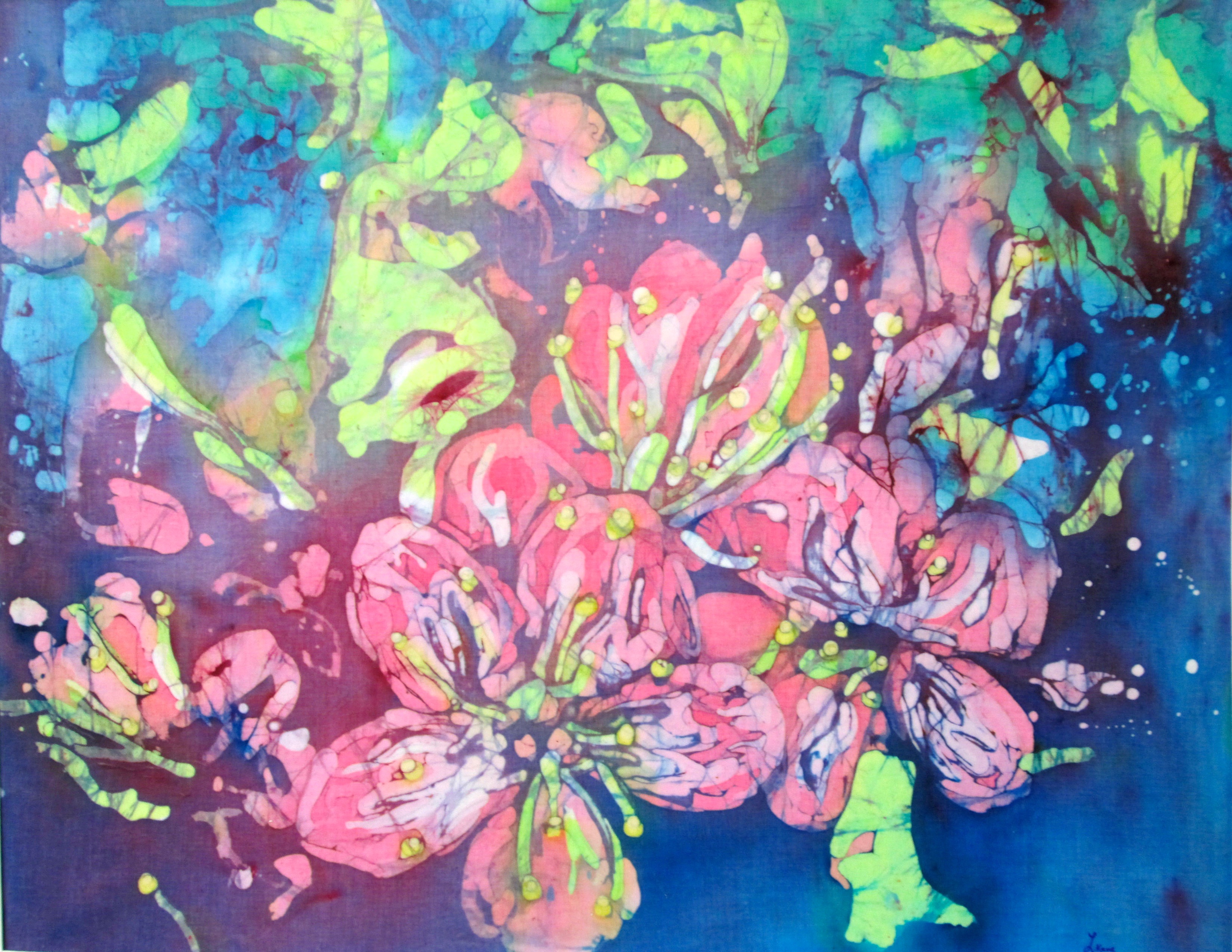
Whenever people ask me about my preferred medium and I reply “Batik” I generally get puzzled looks. I then have to explain the batik process and the history of batik in under a minute. I’ve just finished a unit on batik with high school students and the work they created was absolutely fantastic. Their work inspired me to batik again, as well as to write up a little summary about the process.
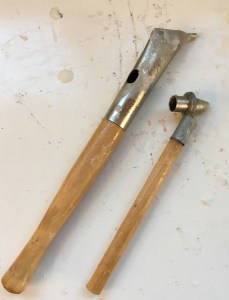
Batiking is a process which originated in Java, it involves fabric dye, fabric, and hot melted wax which is used as a resist. The very first thing the artist must do is preserve any areas of white using the hot melted wax, which is applied to the fabric with a paint brush or a tjanting tool. The tjanting tool is a traditional Javanese tool which is kind of like a little tiny teapot on a handle. The end of the handle has a little pot to hold the melted wax, connected to a tiny spout out of which the melted wax pours onto the fabric.
Once the areas of white are preserved the artist is free to dye the fabric as they please. Personally I really enjoy creating sections of colors that blend together in some areas. This is how I create a watercolor-esque effect in my batiks. Another method of dyeing is to dip the fabric in buckets of dye, the lighter the color desired the less time spent in the bucket.
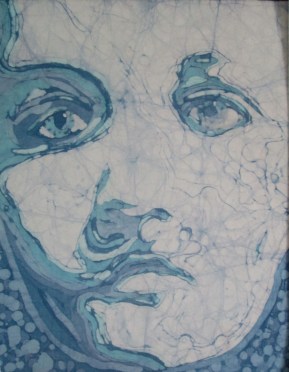
The artist works from light to dark, applying the lightest colors and when the dye is dry applying the melted wax to the areas that should remain the light value. The process repeats until the darkest value is reached. Once the darkest or most saturated dye is applied, the work is almost complete. At this point it isn’t very pretty, all of the wax starts to look like a crusty skin on the fabric, but the very next step reveals the beauty hidden by the wax.
The last step is to iron out the wax. Laying the batik between layers of newsprint (or in my case brown paper grocery bags that I cut strategically to be flat) the wax is melted with the iron and soaked up by the paper. When most of the wax has been soaked up, but there is still a little left, the batik can be ironed flat onto a canvas or board.

 Libby Cruz